
Table of Contents
If you're searching for what "notarized" means in Nepali, you've probably been asked to submit a notarized document — for a visa, a job, a property transaction, or an embassy filing. Here's the direct answer with the Nepali term, how it's used in Nepal's legal practice, and what makes a document properly notarized under Nepali law.
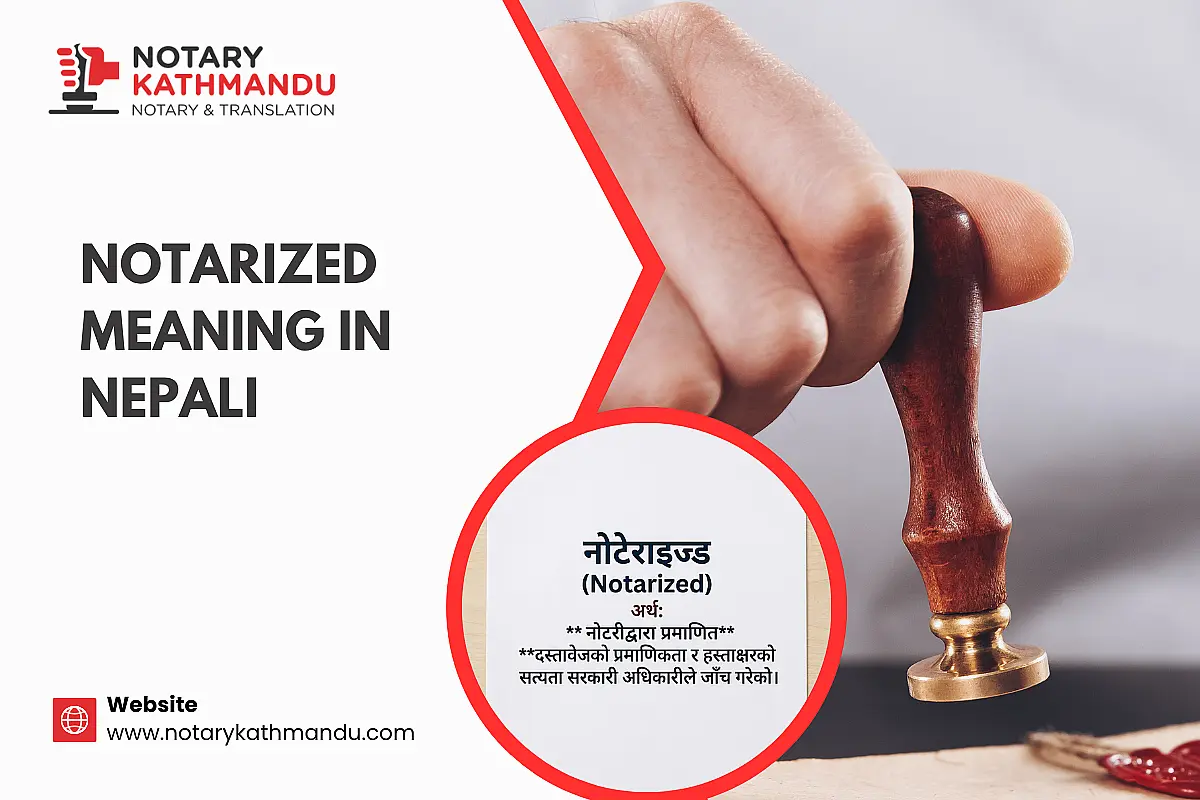
Notarized meaning in Nepali: "नोटराइज्ड" (notaraijd) or नोटरीद्वारा प्रमाणित (notary-dwārā pramāṇit). It refers to a document that has been signed and stamped by a licensed Notary Public — an advocate authorised by the Nepal Notary Public Council under the Notary Public Act 2063 BS. A notarized document carries legal weight in Nepali courts, banks, government offices, and foreign embassies.
Notary Kathmandu provides licensed document notarization and certified true copies by Nepal Notary Public Council-registered advocates.
Get your document notarized today →
What "Notarized" Means in Nepali Legal Practice
In Nepali, the verb "to notarize" is commonly expressed three ways:
- नोटराइज्ड (notaraijd) — the English term transliterated into Devanagari, used directly in everyday speech
- नोटरीद्वारा प्रमाणित (notary-dwārā pramāṇit) — literally "certified by a notary"
- नोटरी प्रमाणन (notary pramāṇan) — "notarial certification" as a noun phrase
All three appear in Nepali legal documents, court filings, and government forms. The most formal of the three is "नोटरीद्वारा प्रमाणित" — this is what you'll typically see on a printed certificate, government instruction, or embassy requirement list.
What Makes a Document "Notarized" Under Nepali Law?
For a document to be properly notarized in Nepal, four conditions must be met under the Notary Public Act 2063 BS:
- A licensed notary performs the act. Only advocates licensed by the Nepal Notary Public Council can notarize. A non-licensed advocate's stamp has no legal effect.
- Personal verification of the signatory. The notary must see the person sign — verification by phone, video, or proxy is not allowed under current Nepali law.
- Entry in the Roznamcha register. Every notarization is logged in the notary's official register with date, document type, and licence number.
- Official seal and signature. The certificate must carry the notary's seal (with their name and licence number) plus their signature.
If any of these is missing, the "notarization" is invalid. Embassies, courts, and banks routinely check for the seal and the licence reference.
Documents Commonly Notarized in Nepal
| Document Type | Common Use |
|---|---|
| Affidavit (शपथपत्र) | Court filing, embassy declaration, name change |
| Power of Attorney (अख्तियारनामा) | NRN property management, business proxy |
| Citizenship copy (नागरिकता प्रतिलिपि) | Foreign bank account, visa application |
| Translated document (अनुवादित कागजात) | Nepali to English for foreign use |
| Marriage certificate (विवाह प्रमाणपत्र) | Spouse visa, family reunification |
| Property deed (राजीनामा/दान-पत्र) | Malpot office filing |
"Notarized" vs "Attested" — Common Confusion
Nepali speakers often use "notarized" and "attested" interchangeably, but they are different in legal practice:
- Notarized (नोटरीद्वारा प्रमाणित) — done by a notary public. Establishes that the signatory appeared, was identified, and signed willingly.
- Attested (प्रमाणित) — a broader term. Can be done by a notary, government officer, embassy, or other authorized entity. The act simply confirms something is true or genuine.
For embassy and foreign use, you typically need BOTH: first a notary's notarization, then often a government attestation (such as by the Ministry of Foreign Affairs) layered on top.
How to Get a Document Notarized in Kathmandu
Three steps:
- Find a licensed notary. Confirm their name is on the Nepal Notary Public Council's public register.
- Bring the original. Notarisation happens on the original document, not a photocopy. Bring your citizenship or passport.
- Pay the fee. Notary fees in Nepal are not fixed by statute and vary by document type, page count, and drafting work — get a quote on WhatsApp before bringing the document in.
Our team are Nepal Bar Council-registered advocates licensed under the Notary Public Act 2063 BS. For details on what we offer, see our document notarization service or the full guide on notary public in Kathmandu.
Conclusion
"Notarized" in Nepali — most commonly "नोटरीद्वारा प्रमाणित" — means a document has been formally certified by a licensed Notary Public under the Notary Public Act 2063 BS. The certification carries legal weight in Nepali courts, banks, and government offices, and is usually the first step before embassy attestation for documents going abroad.
This article is for informational purposes only and does not constitute legal advice, advertisement, or solicitation. Notary Kathmandu and its team are not liable for any consequences arising from reliance on this information. For legal advice, please contact us directly.
Frequently Asked Questions
Common documents include:
- Affidavits (शपथपत्र)
- Powers of attorney (अख्तियारनामा)
- Citizenship copies (नागरिकता प्रतिलिपि)
- Translated documents (अनुवादित कागजात)
- Marriage and birth certificates
- Educational documents and transcripts
- Property deeds and business documents
You can submit and pay online — send the document by WhatsApp or email and pay through eSewa, Khalti, or bank transfer. But the actual notarization must happen on the physical original at a licensed notary's office, as required by the Notary Public Act 2063 BS.






Your Trusted Legal & Notary Partner in Nepal Notary Kathmandu is a premier provider of notary services, legal documentation, and multilingual translation solutions, now proudly managed by Alpine Law Associates. Our mission...
Read More about us