
Table of Contents
Nepal is moving towards a single digital identity that ties together your citizenship, your records, and eventually your access to services — the National Identity Card. Over time it is set to become the document every office asks for first.
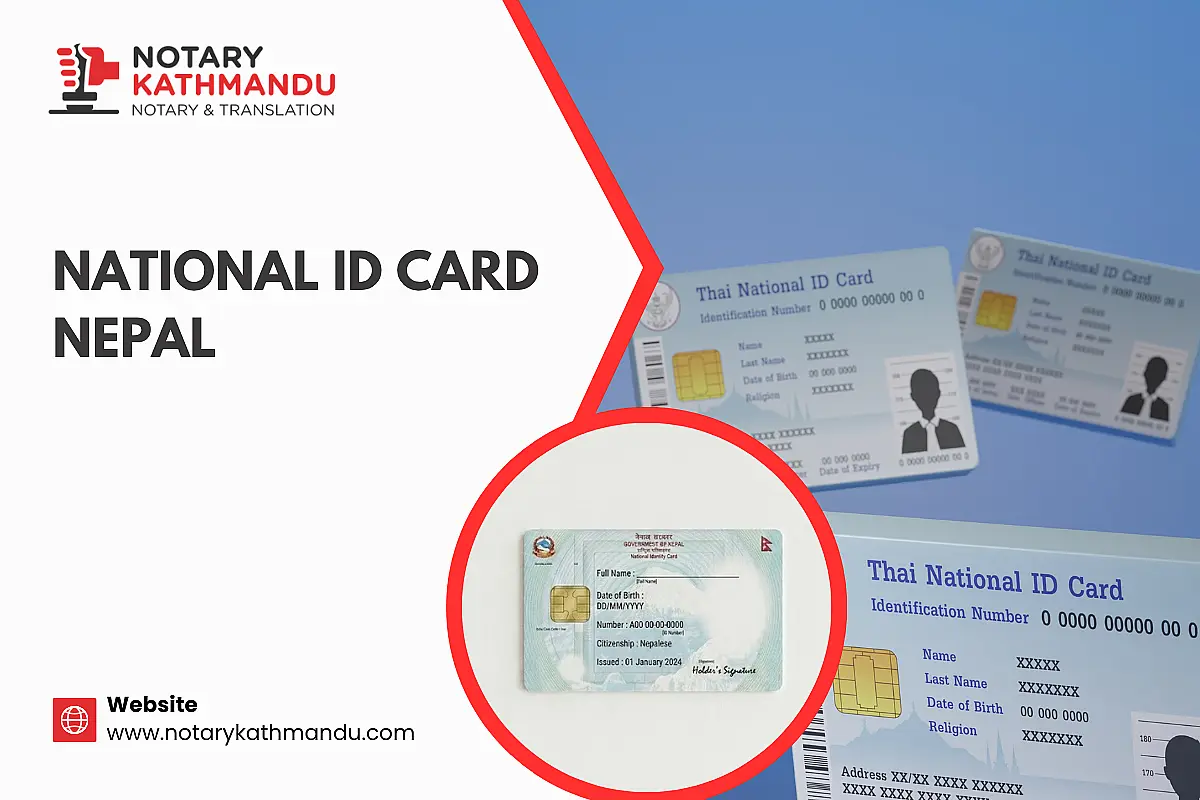
The National Identity Card (Rastriya Parichaya Patra) is issued by the Department of National ID and Civil Registration under a two-step process: online pre-enrollment followed by biometric capture. It is built on your citizenship and carries your fingerprints, photo, and iris data.
This guide explains the National ID Card in Nepal in 2026 — what it is, who can register, the step-by-step process, the documents you need, the fees, and where notarised copies come into the picture.
The National Identity Card (NID) in Nepal is a biometric digital identity issued by the Department of National ID and Civil Registration (DoNIDCR) under the National Identity Card and Registration Act 2076. Any Nepali citizen aged 16 or above with a valid citizenship certificate can register, through online pre-enrollment at the DoNIDCR portal followed by biometric capture (photo, fingerprints, iris, signature) at a District Administration Office. The first card is free; a replacement costs NPR 500.
Notary Kathmandu provides document notarization, certified true copies, and multilingual translation for individuals and businesses across Nepal.
We do not issue the National ID — DoNIDCR does — but where you need a notarised or certified copy of your ID or citizenship, our notary services in Kathmandu can help. Get your documents notarized in Kathmandu →
What Is the National ID Card in Nepal?
The National Identity Card is a single, biometric proof of identity for Nepali citizens. Rather than replacing the citizenship certificate, it builds on it — linking your verified identity to a card and a national database that government services increasingly rely on.
It is governed by the National Identity Card and Registration Act 2076 (2019) and administered by the Department of National ID and Civil Registration (DoNIDCR) under the Ministry of Home Affairs. The long-term goal is one trusted identity used across banking, social security, and public services.
Key takeaway: The NID is a biometric national identity built on your citizenship, issued by DoNIDCR under the National Identity Card and Registration Act 2076.
Who Can Register for a National ID Card?
Eligibility is straightforward. Any Nepali citizen aged 16 or above who holds a valid citizenship certificate can register for the National ID. The citizenship certificate is the anchor document — the NID is issued on the basis of it, so your citizenship details must be accurate and consistent.
Key takeaway: Any Nepali citizen aged 16 or above with a valid citizenship certificate can register — the citizenship certificate is the foundation of the application.
How to Register for the National ID: Step-by-Step
Registration is a two-step process — one online, one in person.
Step 1: Online Pre-Enrollment
Visit the DoNIDCR pre-enrollment portal, create an account with your mobile number, choose "New Enrollment," fill in your personal details, upload your citizenship certificate, select an enrollment centre and appointment date, and print the token slip.
Step 2: Biometric Capture at the Enrollment Centre
Attend your chosen enrollment centre — usually the District Administration Office — on the appointment date with your original citizenship certificate. Staff capture your biometric data: photograph, fingerprints, iris scan, and signature.
Step 3: Verification and Issuance
Your details and biometrics are verified against records, and the National ID is issued. Issuance timelines vary with application volume, from a few weeks to longer.
Key takeaway: Pre-enrol online and upload your citizenship, then attend a District Administration Office for biometric capture — the card follows after verification.
Documents and Fees
The National ID keeps paperwork minimal because it rests on your citizenship.
| Item | Detail |
|---|---|
| Core document | Valid Nepali citizenship certificate |
| Online step | Pre-enrollment form, citizenship upload, token slip |
| In-person step | Original citizenship; biometric capture |
| First card fee | Free |
| Replacement fee | NPR 500 |
Key takeaway: A valid citizenship certificate is the only real document needed; the first card is free and a replacement costs NPR 500.
Where Notarised Copies Come In
The National ID registration itself does not require notarisation — it runs directly through DoNIDCR. But the card and your citizenship are exactly the kind of identity documents that other processes ask you to submit as certified copies.
When you apply for a job abroad, open certain accounts, or submit identity proof to a foreign authority, you are often asked for a certified true copy of your ID or citizenship rather than the original. That is where a notary helps — comparing the copy to the original and certifying it, so you keep your originals safe. For the meaning of the term, see our note on notarized meaning in Nepali.
Key takeaway: NID registration needs no notarisation, but certified copies of your ID and citizenship are routinely needed for jobs, accounts, and submissions abroad.
Common Questions and Mistakes
A few issues trip people up during NID registration:
- Citizenship mismatches — name or detail differences between your citizenship and the form, which stall verification.
- Skipping the appointment — completing pre-enrollment but not attending biometric capture.
- Blurred citizenship upload — an unclear scan that fails the online step.
- Confusing the NID with the citizenship certificate — they are linked but distinct; the citizenship certificate remains your core proof of nationality.
Key takeaway: Match your details to your citizenship exactly, attend the biometric appointment, and remember the NID complements — not replaces — your citizenship certificate.
Conclusion: A Single Identity, Built on Your Citizenship
The National Identity Card is gradually becoming Nepal's central proof of identity. The process is simple — pre-enrol online, attend a District Administration Office for biometrics, and the card follows — and the first card is free.
Notary Kathmandu does not issue the National ID; that is DoNIDCR's role. Where we help is the document layer around it — certified true copies and notarised copies of your ID and citizenship for the many places that ask for them.
If you need certified copies of your identity documents, see our notarization services or talk to our team in Kathmandu. Get your documents notarized in Kathmandu →
Reviewed by: The Legal Team at Notary Kathmandu — Nepal Bar Council registered advocates
Last reviewed: April 2026
This article is for informational purposes only and does not constitute legal advice, advertisement, or solicitation. Notary Kathmandu and its team are not liable for any consequences arising from reliance on this information. For legal advice, please contact us directly.
Frequently Asked Questions
The National Identity Card is a biometric digital identity issued by the Department of National ID and Civil Registration.
Any Nepali citizen aged 16 or above who holds a valid citizenship certificate can register for the National Identity Card.
Yes, the first National ID card is issued free of charge. A replacement card costs NPR 500.
Registration is two steps. First, pre-enrol online at the DoNIDCR portal, fill in your details, upload your citizenship, and book an appointment. Then attend the chosen enrollment centre — usually a District Administration Office — for biometric capture of your photo, fingerprints, iris, and signature.
The main document is a valid Nepali citizenship certificate, which you upload during online pre-enrollment and bring in original for biometric capture. The National ID is issued on the basis of your citizenship, so the details must match exactly.
At the enrollment centre, your photograph, fingerprints, iris scan, and signature are captured. This biometric data is linked to your verified identity in the national database that the card draws on.
The National Identity Card and Registration Act 2076 (2019) governs the National ID, which is administered by the Department of National ID and Civil Registration under the Ministry of Home Affairs.
After biometric capture, issuance times vary with application volume — from a few weeks to several months. The online pre-enrollment and the biometric appointment themselves are quick; the wait is mainly in processing and card production.
No. The National ID complements the citizenship certificate rather than replacing it. Your citizenship certificate remains your core proof of nationality, while the NID provides a single biometric identity that services increasingly rely on.
No. National ID registration runs directly through DoNIDCR and does not require notarisation. Notarisation becomes relevant afterwards, when other processes ask for a certified true copy of your National ID or citizenship rather than the original.
Yes. A notary can issue a certified true copy of your National ID or citizenship certificate by comparing the copy against the original and certifying it. This is useful when a job, account, or foreign authority asks for a copy while you keep the original.
Biometric capture is done at the enrollment centre you select during pre-enrollment, which is usually the District Administration Office. You attend on your booked appointment date with your original citizenship certificate and the token slip from pre-enrollment.
Yes. The first step is online pre-enrollment at the DoNIDCR portal, where you create an account, complete the form, upload your citizenship, choose an enrollment centre and date, and print a token slip to bring to your biometric appointment.
Mismatches between your citizenship certificate and your application can stall verification. Ensure your name and details on the form exactly match your citizenship. If your citizenship itself has an error, that should be corrected first, as the National ID is issued on its basis.
No. The National ID is issued only by the Department of National ID and Civil Registration. Notary Kathmandu helps with the document layer — certified true copies and notarised copies of your ID and citizenship for the places that request them.






Your Trusted Legal & Notary Partner in Nepal Notary Kathmandu is a premier provider of notary services, legal documentation, and multilingual translation solutions, now proudly managed by Alpine Law Associates. Our mission...
Read More about us