
Table of Contents
If you've been asked to submit an "affidavit" in Nepal — for a court case, an embassy filing, a name change, or a property transaction — you may have wondered what the Nepali term is and what the document actually does. Here's the direct answer, the legal use of affidavits in Nepal, and what makes one valid.
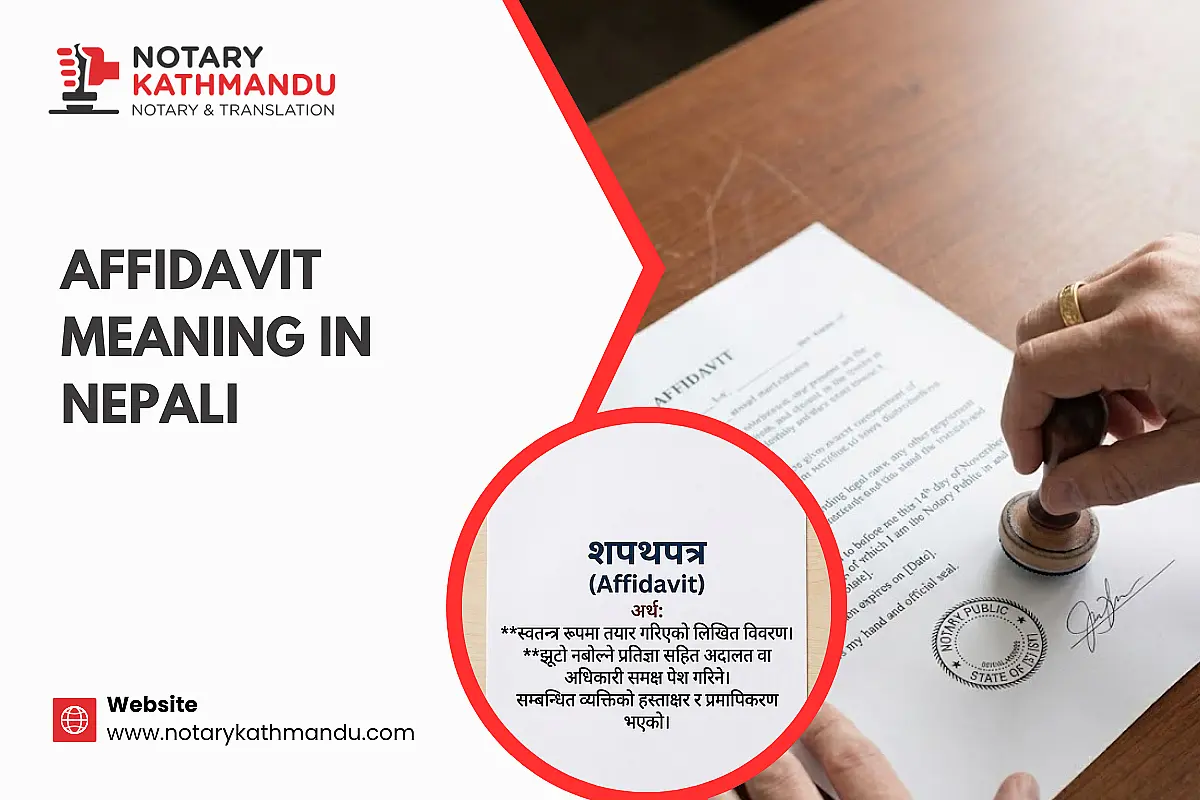
Affidavit meaning in Nepali: शपथपत्र (shapath-patra), literally "oath document". An affidavit is a written statement of fact, signed by the maker under oath or solemn affirmation, and notarized by a licensed Notary Public under the Notary Public Act 2063 BS. It is admissible as evidence in Nepali courts and accepted by government offices, banks, and embassies.
Notary Kathmandu drafts, notarizes, and certifies affidavits (शपथपत्र) for individuals and businesses across Nepal.
Get your affidavit drafted today →
What Is an Affidavit in Nepali Law?
An affidavit (शपथपत्र) is a formal written statement in which the deponent — the person making the statement — swears or solemnly affirms that the contents are true to their knowledge. Under Nepali law, the document becomes legally enforceable once it is signed in the presence of a licensed Notary Public, who attests the signature and adds an official seal.
The word breaks down as:
- शपथ (shapath) — oath or solemn affirmation
- पत्र (patra) — letter or document
Together: "oath document" — a sworn written declaration of fact.
When Affidavits Are Used in Nepal
Affidavits appear in nearly every area of Nepali legal and administrative practice:
| Use Case | Purpose |
|---|---|
| Court filing | Sworn statement of facts for civil or criminal proceedings |
| Name change | Declaring a change of name (also for spelling variation) |
| Embassy / visa | Sponsorship, financial support, relationship declarations |
| Property transactions | Joint ownership declarations, possession affidavits |
| Lost document | Declaring loss of citizenship, passport, or licence |
| Business registration | Director's affidavit, address declaration |
| NRN / spouse status | Marital status, dependent status, residency declarations |
What an Affidavit Must Contain Under Nepali Law
A valid affidavit in Nepal includes:
- Deponent details — full name, father/grandfather name, age, address, citizenship number
- Sworn statement clause — "I solemnly affirm…" (म शपथपूर्वक भन्दछु…)
- Statement of facts — the actual claims being declared
- Concluding declaration — that the contents are true to the deponent's knowledge and that any false statement is punishable by law
- Signature of deponent — signed in the notary's presence
- Notary's attestation — seal, signature, and licence number of the notary, with date
Affidavits can be drafted in either Nepali or English depending on where they will be used. For Nepali courts and government offices, Nepali is standard; for embassy and foreign use, English (or a certified translation) is typical.
Affidavit vs Declaration — Common Confusion
People often use "affidavit" and "declaration" interchangeably. In Nepali legal practice:
- Affidavit (शपथपत्र) — sworn statement, notarized, carries the force of evidence under oath, false statements are punishable
- Declaration (घोषणापत्र) — written statement, may or may not be notarized, lesser evidentiary weight
An affidavit is the stronger of the two and is what courts and embassies typically require.
How to Get an Affidavit Drafted and Notarized in Kathmandu
The process at our office is straightforward:
- Tell us the purpose. WhatsApp or email a brief description of what you need to declare and where the affidavit will be submitted.
- We draft it. Standard affidavit drafting takes a few hours. We send a draft for your review.
- Sign at our office. You sign in the presence of the notary, who attests, seals, and registers the affidavit. The whole sitting takes 15–30 minutes.
- Receive originals. Take the notarized affidavit with you, or we courier it to your address in Kathmandu Valley or anywhere in Nepal.
For more on this service, see our affidavit and sworn statement service page or the broader notary public in Kathmandu guide.
Conclusion
"Affidavit" in Nepali is शपथपत्र (shapath-patra) — a sworn written statement of fact notarized by a licensed Notary Public under the Notary Public Act 2063 BS. It is one of the most commonly required documents in Nepali courts, government offices, and embassy filings. Get it drafted by a registered advocate to ensure the wording satisfies the receiving authority.
This article is for informational purposes only and does not constitute legal advice, advertisement, or solicitation. Notary Kathmandu and its team are not liable for any consequences arising from reliance on this information. For legal advice, please contact us directly.
Frequently Asked Questions
You can submit the brief and pay online via WhatsApp/email and eSewa/Khalti. However, the actual signing must happen in person before the notary — there is no fully remote e-notarization under current Nepali law. Either come to the office or send a representative with a proxy authorisation.
Bring:
- Your citizenship card (or passport for foreigners)
- Any supporting documents related to the statement (e.g., property papers, citizenship of others mentioned)
- A clear brief of what you need to declare





Your Trusted Legal & Notary Partner in Nepal Notary Kathmandu is a premier provider of notary services, legal documentation, and multilingual translation solutions, now proudly managed by Alpine Law Associates. Our mission...
Read More about us