
Table of Contents
Most people in Nepal only discover they need a PAN the day an employer, a bank, or the Land Revenue Office refuses to move without it. By then the deadline is already pressing. The good news is that the process itself is short — the slow part is getting the right documents in order, especially for a business or a family member applying from abroad.
The Permanent Account Number is issued by the Inland Revenue Department (IRD) under the Income Tax Act 2058, and the application now runs almost entirely through the IRD taxpayer portal. If your paperwork is clean, a number can be issued within a few working days.
Here is exactly how PAN card registration in Nepal works in 2026 — who must register, the documents required, the online steps, the one in-person stage you cannot skip, and the supporting documents that have to be notarised before the IRD will accept them.
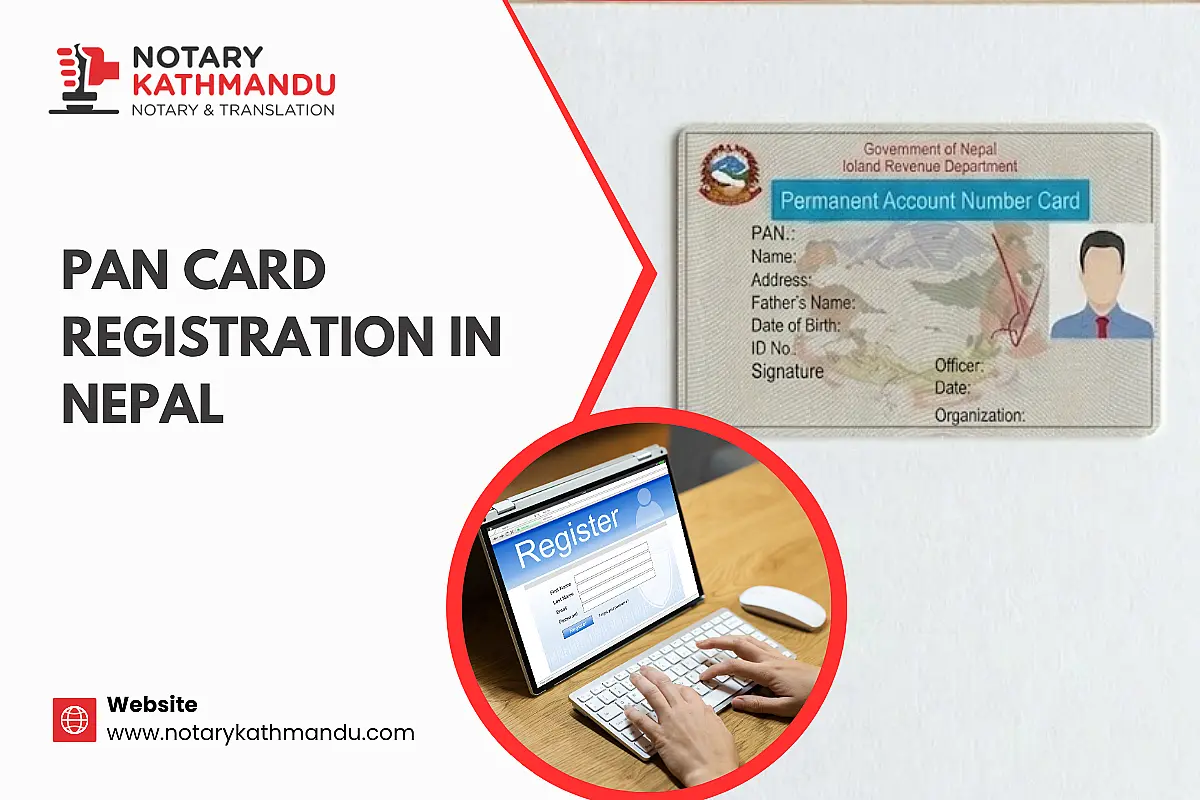
PAN card registration in Nepal is the process of obtaining a Permanent Account Number — a unique tax identity issued by the Inland Revenue Department (IRD) under Section 78 of the Income Tax Act 2058. Individuals apply with a citizenship certificate and photo; businesses apply with their registration certificate and notarised company or partnership documents. Registration is free, done online at taxpayerportal.ird.gov.np, and completed with a one-time biometric verification at an Inland Revenue Office. A PAN is permanent — it never expires and never needs renewal.
Notary Kathmandu provides document notarization, certified true copies, and multilingual translation for individuals and businesses across Nepal.
Registering a company or partnership PAN? The IRD requires notarised supporting documents — our notary services in Kathmandu prepare them the same day. Get your documents notarized in Kathmandu →
What Is a PAN Card in Nepal?
A PAN — Permanent Account Number — is a unique number that identifies you to Nepal's tax system. It is the equivalent of a tax identity card. The Inland Revenue Department links every taxable transaction, salary payment, and return you file to this single number.
The legal basis sits in Section 78 of the Income Tax Act 2058 (2002). The Act states that the Department "shall issue an identity number called a permanent account number to any person" and may require that number to appear on returns and tax documents. In practice, the obligation to actually hold a PAN flows from how the system operates: employers, banks, the Office of the Company Registrar, and the Land Revenue Office will not process you without one.
Two facts surprise most first-time applicants. The number is permanent — it stays with you for life and never expires. And it is free — the IRD charges nothing to issue a PAN, whether personal or business.
Key takeaway: A PAN is a permanent, free tax identity issued by the IRD under Section 78 of the Income Tax Act 2058 — you obtain it once and use it for the rest of your working life.
Who Needs a PAN Card in Nepal?
Far more people are required to hold a PAN than realise it. The practical triggers are clear:
- Salaried employees — public and private. Employers will not put you on the payroll or process tax-compliant salary without your PAN.
- Business operators — companies, firms, partnerships, sole proprietorships, and NGOs, which need a business PAN to invoice, register for VAT, and bid for government contracts.
- Freelancers and consultants billing clients or claiming withholding-tax credit.
- Withholding agents who deduct tax at source under the Income Tax Act 2058.
- Anyone filing an income-tax return under Nepal's current tax slabs or carrying out a transaction the IRD lists as PAN-requiring.
Beyond tax, a PAN has quietly become a gatekeeper for ordinary life. Banks ask for it to open accounts, the Land Revenue Office requires it for property registration, and vehicle bluebook applications increasingly demand it. As of 2026, treat the PAN as a baseline document, not an optional extra.
Key takeaway: If you earn a salary, run a business, file a return, or plan to register property in Nepal, you need a PAN — the only real question is personal or business.
Personal PAN vs Business PAN: Which One Do You Need?
The IRD issues two distinct categories of Permanent Account Number, and choosing the wrong one causes rejections and re-filing. The difference is simply who — or what — is being identified.
| Feature | Personal PAN (P-PAN) | Business PAN |
|---|---|---|
| Issued to | An individual (employee, freelancer, property owner) | A legal entity (company, firm, partnership, NGO) |
| Primary identity document | Citizenship certificate | Business / company registration certificate |
| Tied to | The person | The entity — survives ownership changes |
| Used for | Salary, personal tax returns, bank accounts | Invoicing, VAT registration, government procurement |
| Supporting documents | Citizenship + photo | Registration certificate + notarised MOA/AOA or partnership deed |
A personal PAN cannot be used to run a business or raise tax invoices. If you start commercial activity later, you can apply to the IRD to convert a personal PAN into a business PAN rather than starting from scratch. For NGOs, partnerships, and private limited companies, the registration certificate from the relevant authority — the Office of the Company Registrar for companies — is the anchor document.
Key takeaway: Use a personal PAN for employment and individual income; use a business PAN the moment you invoice, register for VAT, or bid for contracts.
PAN vs VAT vs Business Registration: What's the Difference?
New business owners routinely confuse three separate registrations. They are sequential, not interchangeable, and skipping the order causes problems.
| Registration | What It Establishes | When It Is Required |
|---|---|---|
| Business / company registration | The legal existence of the entity (Office of the Company Registrar, ward, or relevant registrar) | Before you start operating |
| Business PAN | The entity's tax identity with the IRD | Mandatory for every business, regardless of turnover |
| VAT | Authority to charge and remit Value Added Tax | Once annual turnover crosses NPR 50 lakh (goods) or NPR 30 lakh (services or mixed), within 30 days |
The order matters: you register the business first, obtain its PAN, and only then register for VAT if your turnover crosses the threshold. A PAN is mandatory for all business entities; VAT is triggered only by turnover, though any business may register for VAT voluntarily. In short, every VAT-registered business has a PAN, but not every PAN-registered business needs VAT.
Key takeaway: PAN comes before VAT — every business needs a PAN, but VAT only kicks in above the NPR 50 lakh (goods) or NPR 30 lakh (services) turnover threshold.
Documents Required for PAN Card Registration in Nepal
This is where applications stall. The IRD verifies originals against your uploads, so the list has to be exact. The PAN card documents required differ sharply between personal and business applicants.
Documents for Personal PAN Registration
- Citizenship certificate — clear scans of both sides
- One recent passport-size photograph
- An active Nepali mobile number for OTP verification
- Proof of address — a utility bill or ward letter (requested by some offices)
Foreign nationals and Non-Resident Nepalis (NRNs) who do not hold Nepali citizenship submit a passport copy and a valid visa in place of the citizenship certificate. Where the passport or supporting papers are in a language other than Nepali or English, the IRD will expect a certified translation in Nepal attached to the file.
Documents for Business PAN Registration
- Business or company registration certificate (Office of the Company Registrar, ward office, or the relevant registrar)
- For a company: notarised Memorandum of Association (MOA) and Articles of Association (AOA)
- For a partnership: the notarised partnership deed
- Citizenship certificates of all directors, the proprietor, or the partners
- The tax registration application form (generated on the IRD portal)
- Lease agreement or ownership document for the business premises
- Passport-size photographs of the directors or proprietor
The notarisation requirement on company and partnership documents trips up many new businesses. The IRD and the Company Registrar will not accept an MOA, AOA, or partnership deed without proper notarial certification. Our legal document drafting service prepares and notarises these in a single visit, and where you need stamped copies of citizenship or the registration certificate, certified true copies are issued on the spot.
Photo and Scan Specifications
Rejected uploads are almost always a scan problem, not a missing document. The IRD verifies your originals against the files you upload, so quality matters.
| Item | Requirement |
|---|---|
| Photograph | Recent passport-size photo, plain light background, face clearly visible |
| Citizenship scan | Both front and back, in focus, all text legible |
| File format | Common image or PDF format, not blurred or cropped at the edges |
| Business documents | Clear scans of the notarised originals, with the notarial seal visible |
Key takeaway: Personal applicants need citizenship and a photo; business applicants need their registration certificate plus notarised MOA/AOA or a notarised partnership deed — assemble these before you touch the portal.
PAN Registration for Foreign Nationals and NRNs
Foreign nationals and Non-Resident Nepalis can hold a Nepali PAN, and many need one — to draw a salary, run an investment, or operate a business here. The route is the same IRD portal, but the documents and eligibility differ.
Eligibility is tied to your visa status. Holders of a valid work permit, business visa, or diplomatic visa can register. Tourist-visa holders generally cannot — a PAN follows a legitimate economic or employment purpose in Nepal.
The typical document set for a foreign applicant is:
- Passport copy (photo and details page)
- Valid visa confirming lawful stay in Nepal
- Work permit, if employed
- Employer or sponsor recommendation letter, where applicable
- A local address in Nepal
Where any of these documents is in a language other than Nepali or English, attach a certified translation. Our multilingual translation and verification service handles passports and foreign corporate papers, and where the receiving authority later asks for onward government attestation, that is a separate step you arrange directly with the relevant office.
Key takeaway: Foreign nationals on a work, business, or diplomatic visa can register a PAN with a passport, visa, and — if employed — a work permit; tourist-visa holders are not eligible.
How to Register a PAN Online in Nepal: Step-by-Step
The IRD has moved online PAN registration onto its taxpayer portal, and the bulk of the work is done from a laptop. Here is the full sequence as it runs in 2026.
Step 1: Open the Taxpayer Portal
Go to taxpayerportal.ird.gov.np. Under the Taxpayer Portal menu, expand "Registration (New)" and open the application for registration. You can also start the process through the Government of Nepal's Nagarik App, which now integrates PAN registration.
Step 2: Choose Your Taxpayer Type
Select whether you are registering as an individual (personal PAN) or a business entity. This choice sets the entire form, so confirm it before continuing. Pick the wrong type and you start again.
Step 3: Fill the PAN Application Form
Complete the form with your details exactly as they appear on your citizenship certificate or registration certificate — full name, date of birth in BS, district, ward, and contact number. The system generates a submission number; note it down, as you will need it at the office. Spelling that does not match your documents is the single most common cause of rejection.
Step 4: Select Your Inland Revenue Office
From the dropdown, choose the Inland Revenue Office (IRO) or Taxpayer Service Office (TSO) where you will complete verification. In the capital, applicants typically select an office within Kathmandu District; choose the one nearest your home or registered business address.
Step 5: Upload Your Documents
Upload clear scans of every required document — citizenship (both sides) and photo for individuals, or the registration certificate and notarised company documents for businesses. Blurred or cropped scans get bounced, so check each file before submitting.
Step 6: Complete Biometric Verification in Person
This is the one stage you cannot do from home. Visit your selected IRO or TSO with the originals of every uploaded document. An officer verifies the originals against your scans, captures your fingerprint and photograph, and confirms your details. Only after this biometric step does the IRD officially issue the number.
Step 7: Receive and Collect Your PAN
Once verification clears, the PAN is issued — usually within 1 to 3 working days. You can download the PAN certificate from the portal and collect the physical PAN card from your assigned office.
Registering via the Nagarik App or In Person
The portal is not the only route. The Government of Nepal's Nagarik App now offers PAN registration from your phone — select the PAN service, fill the same details, upload the same documents, and complete biometric verification at your chosen office. The steps mirror the web portal.
You can also register entirely in person at your nearest Inland Revenue Office or Taxpayer Service Office. Carry the originals and copies of every required document; staff complete the form, capture your biometrics, and issue the PAN. This suits anyone uncomfortable with online forms, or businesses with bulky notarised paperwork to hand over directly.
However you apply, the PAN certificate can be downloaded from the IRD portal once issued — keep a soft copy, as employers and banks frequently ask for it.
Need help with the documents before you file? Our notary in Kathmandu prepares and certifies them daily →
Key takeaway: The form, upload, and submission happen online, but a one-time in-person biometric visit to your Inland Revenue Office is mandatory before the PAN is issued — there is no fully remote shortcut.
The PAN Application Form: A Quick Walkthrough
The online form looks long, but most fields are routine. Knowing what each section wants prevents the back-and-forth that adds days to the process.
- Taxpayer type — individual or entity; this drives every later field.
- Personal / entity details — name, date of birth (BS), gender, and parents' or directors' names, matching your documents letter for letter.
- Address — permanent and current, down to district and ward number.
- Contact — the mobile number that receives your OTP and the SMS confirming your PAN.
- Office selection — the IRO or TSO that will handle your verification.
- Document upload — the scans listed in the section above.
For a business, the form also asks for the registration date, registration number, business address, and the principal activity. Have the registration certificate open beside you so these match precisely. Once submitted, the form cannot be casually edited — corrections mean a fresh trip to the office.
How to Verify or Search a PAN Number in Nepal
Once you have a PAN, you — or an employer, bank, or business partner — can confirm it is genuine in seconds. The IRD runs a free public lookup at ird.gov.np/pan-search.
Enter the PAN number, complete the captcha, and click search. The tool returns the registered name, address, the issuing office, and the PAN's status. The same check is available through the Nagarik App, which reads the same IRD database.
One privacy limit is worth knowing: you cannot search by a person's name. The system only accepts the PAN number itself, which stops casual snooping. Businesses use this lookup to verify a supplier's PAN before raising invoices or deducting tax at source.
Key takeaway: Verify any PAN free at ird.gov.np/pan-search using the number and a captcha — name-based search is blocked, so you always need the PAN number to check details.
How Long Does PAN Registration Take, and What Does It Cost?
Speed depends almost entirely on your paperwork, not on the IRD.
| Stage | Typical Time |
|---|---|
| Online form + document upload | 15–30 minutes |
| Booking and attending biometric verification | Same day to a few days, depending on the office queue |
| PAN issued after verification | 1–3 working days |
| Notarising business documents (if needed) | Often same day with a notary |
On cost, the position is simple: the IRD charges no fee for PAN registration, personal or business. The only money a business spends is on preparing and notarising the supporting documents the IRD requires — not on the PAN itself, and notary fees in Nepal depend on page count and drafting work rather than a fixed schedule. Be wary of anyone "selling" you a PAN; the registration is genuinely free.
Key takeaway: PAN registration is free at the IRD, and a clean application is usually issued within 1–3 working days of biometric verification.
Can a Representative Register a PAN on Your Behalf?
Yes — and this is the common path for NRNs and busy business owners. If you cannot attend in person, an authorised representative can act for you, but the IRD and the office will expect proof that the person genuinely speaks for you.
That proof is usually a notarised authorisation letter or, for broader powers, a power of attorney. An NRN abroad will typically have the document notarised, and any onward attestation required by the receiving authority is a separate step handled directly with that authority. The biometric stage, however, generally still requires the applicant — so plan a personal PAN around your own availability where possible.
Key takeaway: A representative can file and submit documents with a notarised authorisation or power of attorney, but the applicant's biometric verification usually cannot be delegated.
Common Mistakes That Delay PAN Registration
In our experience preparing PAN documents for Kathmandu clients, the same handful of errors cause almost every rejection:
- Name spelling mismatches — the form must match the citizenship or registration certificate exactly, including middle names.
- Single-side citizenship scans — both front and back are required.
- Un-notarised company documents — submitting an MOA, AOA, or partnership deed without notarial certification is an instant bounce for business PAN.
- Choosing the wrong taxpayer type — registering personal when you need business, or vice versa.
- Skipping the biometric visit — assuming the online submission alone issues the PAN.
Fixing any of these after submission means another office visit. Getting the documents right the first time is the whole game.
Key takeaway: Match every detail to your source documents, scan both sides of citizenship, and notarise business documents before filing — these three habits prevent the vast majority of delays.
What Happens If You Don't Register for a PAN?
There is a lot of confusion online about PAN penalties, and much of it is inaccurate. Section 78 of the Income Tax Act 2058 governs the issuing of the PAN itself; it does not set a fixed fine for individuals who delay registration. The penalty provisions in Section 117 deal with failures to file returns or maintain documents — not a standalone PAN-registration fine. So treat any article quoting a precise "PAN penalty" with caution.
The real consequences are practical and immediate rather than a single headline fine:
- Employers cannot legitimately put you on the payroll or process compliant salary.
- You cannot file an income-tax return or claim credit for tax withheld on your income.
- Banks may decline to open accounts, and the Land Revenue Office refuses property transactions without it.
- Vehicle bluebook applications and government contract bids stall.
In short, the cost of not having a PAN is being locked out of formal financial life — which is why it has become a baseline document in 2026.
Conclusion: Get Your Documents Ready First
PAN card registration in Nepal is genuinely straightforward once your paperwork is clean. The form takes half an hour, the IRD charges nothing, and a number usually lands within a few working days of your biometric visit. The friction is never the portal — it is the supporting documents, and for businesses, the notarial certification the IRD insists on.
That is exactly where we help. We do not register your PAN — the IRD does that, free of charge. What we do is prepare the documents that get accepted the first time: notarised MOA and AOA, partnership deeds, certified true copies of citizenship and registration certificates, certified translations for foreign passports, and the authorisation or power of attorney a representative needs.
If you are registering a company or partnership PAN, or applying from abroad, send your documents to our notary in Kathmandu and get them notarised and ready — often the same day. Get your documents notarized in Kathmandu →
Reviewed by: The Legal Team at Notary Kathmandu — Nepal Bar Council registered advocates
Last reviewed: April 2026
This article is for informational purposes only and does not constitute legal advice, advertisement, or solicitation. Notary Kathmandu and its team are not liable for any consequences arising from reliance on this information. For legal advice, please contact us directly.
Frequently Asked Questions
A PAN is a Permanent Account Number — a unique tax identity issued by Nepal's Inland Revenue Department under the Income Tax Act 2058.
Yes. The Inland Revenue Department charges no fee for PAN registration, whether personal or business. The PAN itself is always free.
A clean application is usually issued within 1 to 3 working days after you complete biometric verification at your Inland Revenue Office.
Salaried employees, business operators, freelancers, withholding agents, and anyone filing an income-tax return must hold a PAN. In practice, banks, the Land Revenue Office, and employers all require it, so most working adults in Nepal now need one for both tax and everyday financial transactions.
For a personal PAN you need clear scans of both sides of your citizenship certificate, one recent passport-size photograph, and an active mobile number for OTP verification. Some offices also ask for proof of address, such as a utility bill or ward letter. Foreign nationals submit a passport and valid visa instead of citizenship.
You can complete the form, upload documents, and submit your application online at taxpayerportal.ird.gov.np or via the Nagarik App. However, a one-time in-person biometric verification at your Inland Revenue Office is mandatory before the PAN is officially issued. There is no fully remote option.
A personal PAN identifies an individual and uses a citizenship certificate; it is for salary and personal tax. A business PAN identifies a legal entity — a company, firm, or partnership — using its registration certificate, and is required for invoicing, VAT registration, and government contracts. A personal PAN cannot be used for business.
A business PAN requires the registration certificate, citizenship of the directors or proprietor, premises proof, photographs, and the tax registration form. Companies must add a notarised Memorandum and Articles of Association; partnerships must add a notarised partnership deed. The IRD will not accept these company documents without notarial certification.
Personal PAN applications generally do not require notarisation. Business PAN applications do — the Memorandum and Articles of Association for companies, and the partnership deed for firms, must be notarised before the IRD or the Office of the Company Registrar will accept them. Certified true copies of citizenship are also commonly requested.
Yes. An authorised representative can file and submit documents for you using a notarised authorisation letter or a power of attorney — common for NRNs and busy business owners. However, the biometric verification stage usually still requires the applicant to appear in person at the Inland Revenue Office.
Yes. Foreign nationals and Non-Resident Nepalis who do not hold Nepali citizenship register using a passport copy and a valid visa in place of the citizenship certificate. Foreign-language documents typically need a certified translation attached, and onward attestation, if required, is handled separately with the relevant authority.
Section 78 of the Income Tax Act 2058 does not set a fixed individual fine for late registration. The real consequences are practical: employers cannot put you on the payroll, you cannot file returns or claim tax-withholding credit, and banks, the Land Revenue Office, and vehicle registration all refuse to proceed without a PAN.
No. A Permanent Account Number is exactly that — permanent. It stays with you or your entity indefinitely and never requires renewal. For a business, it remains valid throughout the life of the entity regardless of ownership changes.
Yes. If you start commercial activity after holding a personal PAN, you can apply to the Inland Revenue Department to convert it into a business PAN rather than registering from scratch. You will need to submit the business registration certificate and the related notarised company or partnership documents.
PAN is issued by the Inland Revenue Department through its Inland Revenue Offices (IRO) and Taxpayer Service Offices (TSO). When applying online you select the office nearest your home or registered business address — in the capital, typically an office within Kathmandu District — where you complete biometric verification and collect the card.






Your Trusted Legal & Notary Partner in Nepal Notary Kathmandu is a premier provider of notary services, legal documentation, and multilingual translation solutions, now proudly managed by Alpine Law Associates. Our mission...
Read More about us