
Table of Contents
If you've come across the word "sworn" — in a court order, an embassy form, or a legal document — you've probably wondered what it means in Nepali and what the legal weight of a "sworn" statement actually is. Here's the direct answer, the Nepali term, and how the concept works in Nepali law.
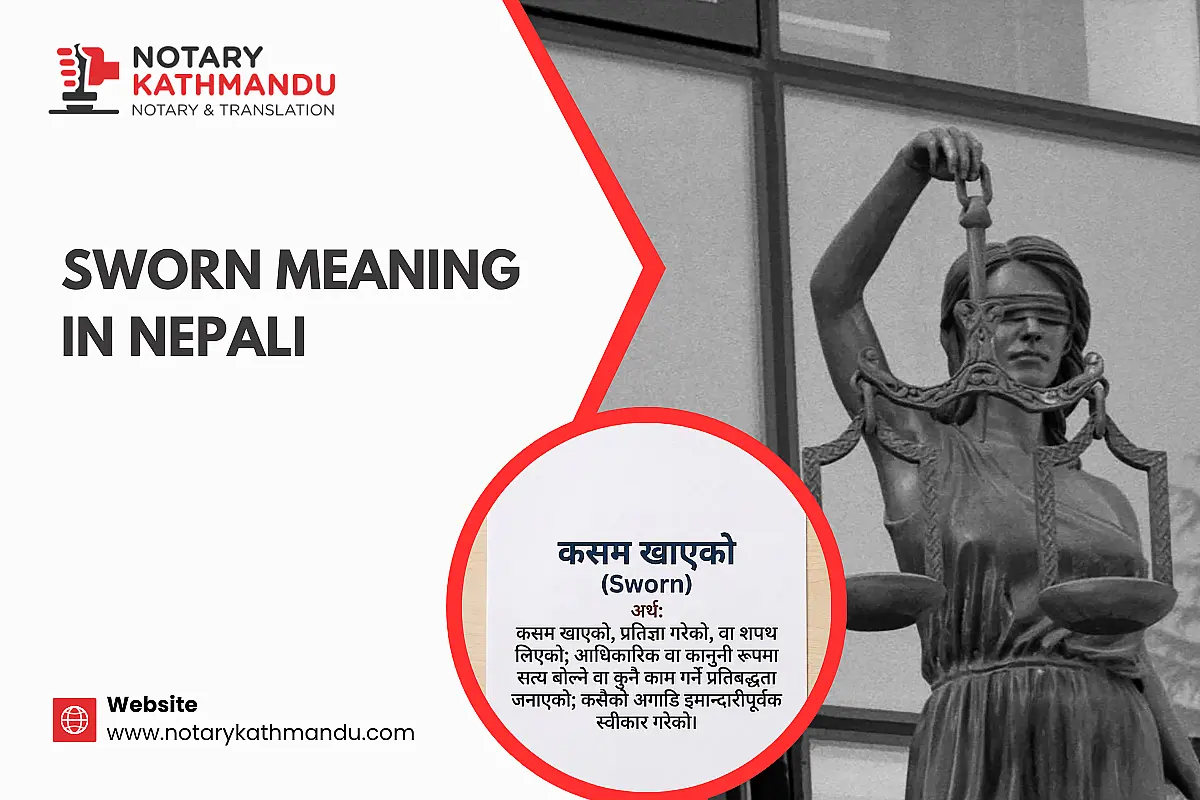
Sworn meaning in Nepali: शपथग्रहित (shapath-grahit) or शपथपूर्वक (shapath-pūrvak) — literally "under oath" or "by solemn affirmation". A "sworn" statement is one made under formal oath before a notary public or other authorized authority. Under the Notary Public Act 2063 BS, sworn statements carry the force of evidence in Nepali courts and false declarations are punishable.
Notary Kathmandu drafts and notarizes sworn statements, affidavits, and oath-based declarations across Nepal.
Get your sworn statement notarized →
What "Sworn" Means in Nepali Legal Practice
"Sworn" describes a statement, oath, or affirmation made formally — typically before a Notary Public, a judge, or another authorized authority — in which the speaker commits that what they are saying is true on pain of legal penalty. In Nepali, this is most commonly expressed as:
- शपथग्रहित (shapath-grahit) — "having taken an oath" — used as an adjective ("sworn statement")
- शपथपूर्वक (shapath-pūrvak) — "with oath" — used adverbially ("I solemnly affirm")
- शपथ खाएको (shapath khāeko) — "having sworn an oath" — informal usage
The root word शपथ (shapath) means "oath". It comes from Sanskrit and appears in Nepal's law codes, court orders, government forms, and treaty documents.
Types of Sworn Documents Used in Nepal
The "sworn" label appears on several document types in Nepali legal practice:
| Document Type | Nepali Term | Purpose |
|---|---|---|
| Sworn statement | शपथग्रहित बयान | Court evidence, embassy declarations |
| Affidavit | शपथपत्र | Written sworn declaration |
| Sworn translation | शपथग्रहित अनुवाद | Translator certifies accuracy under oath |
| Sworn deposition | शपथसहित बकपत्र | Court witness testimony |
| Oath of office | पद ग्रहण शपथ | Government officials, advocates, public servants |
How a Statement Becomes "Sworn" in Nepal
A statement becomes sworn through a formal act of attestation. Under the Notary Public Act 2063 BS, the process at a notary's office works like this:
- The notary identifies the deponent. Personally — by citizenship card or passport. Identification by phone or proxy is not accepted.
- The deponent reads and understands the statement. If the document is in a language the deponent does not read fluently, it must be read aloud or translated.
- The deponent takes the oath. Standard wording: "म शपथपूर्वक भन्दछु…" (I solemnly affirm…) — committing that the contents are true.
- The deponent signs in the notary's presence. The notary observes the signing directly.
- The notary attests. Adds official seal, signature, licence number, and date. Entry is made in the notary's official register (Roznamcha).
From that moment forward, the document is legally a "sworn" instrument.
Why Sworn Statements Matter
A sworn statement is the legal equivalent of giving evidence in court. The deponent commits to the truth of the contents on penalty of perjury — false statements expose them to fines, criminal prosecution, and consequences in any underlying matter.
This is why embassies, courts, and large institutions prefer sworn statements over unsworn declarations: there is enforceable accountability if the statement turns out to be false.
"Sworn" vs Unsworn — When the Distinction Matters
- Sworn statement (शपथग्रहित बयान) — notarized, carries evidentiary weight, false declaration is punishable, accepted by courts and embassies
- Unsworn declaration (घोषणापत्र) — written statement, no oath, lesser evidentiary weight, may be sufficient for routine internal use but rejected for formal filings
If you've been asked to "submit a sworn statement", a regular declaration will not suffice — you need a notary's attestation under oath.
How to Get a Sworn Statement Made in Kathmandu
Three simple steps at our office:
- Brief us. WhatsApp or email a description of what needs to be sworn and where the document will be submitted.
- We draft the statement. With the proper sworn clause, deponent details, and concluding declaration. Standard turnaround is a few hours.
- Sign and notarize at the office. You take the oath, sign in the notary's presence, and walk out with the sealed sworn statement. The sitting takes 15–30 minutes.
See our affidavit and sworn statement service for the full scope, or read more about the Nepal Notary Public Council that regulates notaries.
Conclusion
"Sworn" in Nepali — most commonly शपथग्रहित or शपथपूर्वक — describes a statement made formally under oath, typically before a Notary Public. Sworn documents carry legal weight in Nepali courts and are recognised by embassies, banks, and government offices worldwide. Get yours drafted by a registered advocate to ensure the oath wording satisfies the receiving authority.
This article is for informational purposes only and does not constitute legal advice, advertisement, or solicitation. Notary Kathmandu and its team are not liable for any consequences arising from reliance on this information. For legal advice, please contact us directly.
Frequently Asked Questions
Authorized oath-administrators in Nepal include:
- Notary Publics licensed by the Nepal Notary Public Council
- Judges and judicial officers
- Ministers, government secretaries (for oaths of office)
- Authorized embassy officers (for documents intended for that country)







Your Trusted Legal & Notary Partner in Nepal Notary Kathmandu is a premier provider of notary services, legal documentation, and multilingual translation solutions, now proudly managed by Alpine Law Associates. Our mission...
Read More about us